
Oregon Trucking Online (TOL)
TOL

A divisible load is made up of more than one piece. These may be identical items, boxed or unboxed, bundled or loose, or a variety of items that can be hauled together within legal limits. A divisible load is a multi-item load that may not be loaded in such a way that it exceeds legal limits unless expressly allowed by special permit exception. These statutory exceptions are very limited. This category refers to general freight and cargo loads.
When referenced to weight, a divisible load must comply with legal axle weight formulas shown on Permit Weight Table 1 and is limited to no more than 80,000 pounds gross. Divisible loads being hauled by combinations with an appropriate wheelbase and number of axles may, by permit, be allowed to exceed the 80,000 pound limit up to a maximum of 105,500 pounds gross. These extended weights are shown on Permit Weight Table 2.
For divisible loads, the loaded weight of any group of axles, vehicle, or combination of vehicles shall not exceed that specified in these two tables of weights, or any of the following:
For calculating weights for divisible loads make sure the proper selection has been made on the Entry screen.
A non-divisible load or vehicle for the purposes of weight calculations is a load or vehicle that consists of a single item, that is usually large and heavy such as a piece of construction, industrial, or structural equipment or machinery.
Under the Code of Federal Regulations non-divisible means any load or vehicle exceeding applicable length or weight limits which, if separated into smaller loads or vehicles would:
Loads qualifying as single, non-divisible item may be allowed, by permit, to operate with increased axle and axle group weights based on formulas shown on Permit Weight Tables 3 and 4.
For calculating weights for single, non-divisible item loads make sure the proper selection has been made on the Entry screen.
Note: Per Oregon Administrative Rule 734-082-0010 (2), by permit, unladen self-propelled or towed fixed-load vehicles, equipped with low pressure flotation tires (15-inch or larger) shall be permitted 700 pounds per inch of tire width to a maximum of 36,000 pounds on any single axle or 43,000 pounds on any tandem axle.
The weight analysis program will not allow for a single axle over 21,500 pounds.
For assistance with these calculations, please contact 503-373-0000, Option 1.
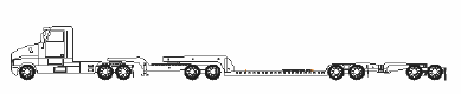
Weight Table 5 describes maximum weights up to 24,000 pounds per axle and 48,000 pounds per tandem axle when the combination consists of a steering axle and a minimum of four or more consecutive tandem axles. See example below. If the combination does not have at least four consecutive sets of tandem axles, and at least 9 axles on the ground, it does not qualify for Weight Table 5 weights.
Additional weight may be allowed for tandem axles that are 10 feet wide, as long as the combination has at least four consecutive sets of tandem axles. The weight analysis calculator will not calculate this additional weight.
For assistance with these calculations, please contact 503-373-0000, Option 1.
Example
Enter the total number of axles for the vehicle or combination. This includes the steering axle and any lift/drop axles that will be on the ground during movement. Note: If operating in excess of 80,000 pounds, all lift/drop axles must be down.
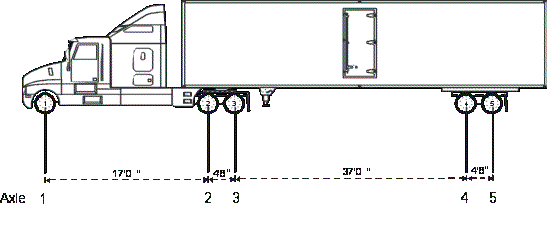
Axle spacings are measured from the center of the first axle (number 1) to the center of the next axle (number 2), then from the center of number 2 to the center of number 3. Repeat this process until the last axle is reached. Enter the distance in feet and inches between the centers of each consecutive axle (including any lift/drop axle that must be down). Use even inches only. No fractions or decimals are allowed. The program is formatted to display all axle spacings in feet and inches.
Axle spacings are measured from the center of the first axle (number 1) to the center of the next axle (number 2), then from the center of number 2 to the center of number 3. Repeat this process until the last axle is reached. Enter the distance in inches between the centers of each consecutive axle (including any lift/drop axle that must be down). Use even inches only. No fractions or decimals are allowed. The program is formatted to display all axle spacings in feet and inches.
Press this button to move on to the graph screen. If you have made any changes to the entries a pop up window will ask if you are sure. This is designed to provide you with a chance to confirm your changes and to make sure everything looks correct before moving on.
If you want to start another weight calculation, just click on this button to automatically move back to the entry screen and start a new one.
The Graph screen provides the user with a visual display of the axle configuration layout along with spacings and weights. It also provides a quick confirmation of the number of axles entered, load type, and gross weight. If any of this looks incorrect then click on the 'Entry' screen and make appropriate changes.
The number of axle spacings to be entered is based on the total number of axles designated on the 'Entry' screen. When determining axle spacings, measure from the center of one axle to the center of the next axle.
Measurements must be entered according to the user's selection of 'Feet and Inches' or 'Inches Only'.
Enter the actual or requested weight for each axle, tandem axle or group of axles in the vehicle or combination. The Steer Axle is considered the first group and consists of 1 axle. The Tandem Axle is the next axle group consisting of 2 axles, etc. Note that a tridem or quad axle is considered a group of 3 or 4 but that any axle in that group can be singled out for allowable/permittable weights.
Users may refer to the Weight Table Charts to determine weights allowed based on spacings, type of load (divisible vs. non-divisible), and weight table formulas.
Note: The Weight Tables assume an axle(s) or axle group with dual tires on each side. For single tire axle(s) application such as a steer axle or auxiliary axle (lift, flip, etc.) weight authorized for those axles defaults to weights based on tire width. This includes a single tire axle that is part of a multiple axle group. Refer to Tire Size.
For axles with dual tires, weight cannot exceed 24,000 lbs. on any one axle of a group of axles even if the axle group weight is in compliance.
Enter the actual or requested weight for each axle, tandem axle or group of axles in the vehicle or combination. The Steer Axle is considered the first group and consists of 1 axle. The Tandem Axle is the next axle group consisting of 2 axles etc. Note that a tridem or quad axle is considered a group of 3 or 4 but that any axle in that group can be singled out for allowable/permittable weights.
Users may refer to the Weight Table Charts to determine weights allowed based on spacings, type of load (divisible vs. non-divisible), and weight table formulas.
Note: The Weight Tables assume an axle(s) or axle group with dual tires on each side. For single tire axle(s) application such as a steer axle or auxiliary axle (lift, flip, etc.) weight authorized for those axles defaults to weights based on tire width. This includes a single tire axle that is part of a multiple axle group. Refer to Tire Size.
For axles with dual tires, weight cannot exceed 20,000 lbs. on any one axle of a group of axles even if the axle group weight is in compliance.
Enter the actual or requested weight for each axle, tandem axle or group of axles in the vehicle or combination. The Steer Axle is considered the first group and consists of 1 axle. The Tandem Axle is the next axle group consisting of 2 axles etc. Note that a tridem or quad axle is considered a group of 3 or 4 but that any axle in that group can be singled out for allowable/permittable weights.
Users may refer to the Weight Table Charts to determine weights allowed based on spacings, type of load (divisible vs. non-divisible), and weight table formulas.
Note: The Weight Tables assume an axle(s) or axle group with dual tires on each side. For single tire axle(s) application such as a steer axle or auxiliary axle (lift, flip, etc.) weight authorized for those axles defaults to weights based on tire width. This includes a single tire axle that is part of a multiple axle group. Refer to Tire Size.
For axles with dual tires, weight cannot exceed 21,500 lbs. on any one axle of a group of axles even if the axle group weight is in compliance.
The number of axle spacings to be entered is based on the total number of axles designated on the 'Entry' screen. When determining axle spacings, measure from the center of one axle to the center of the next axle.
Measurements must be entered according to the user's selection of 'Feet and Inches' or 'Inches Only'.